
Paul Landauer - Post-démolition, L’architecture face aux nouvelles ruines
"We are currently facing a major paradox: a new world needs to be built, but we no longer have the means to do so. Climate change alone requires a completely new approach to building design; a rise in sea levels and an increase in natural disasters call for a rethink of the location and organisation of human settlements; planetary limits demand a profound reorganisation of land use and construction. The fact is, however, that the world, burdened by two centuries of intense production, needs a respite; it cannot accept the demolition of existing structures and the construction of new facilities, which would increase its carbon footprint and further deplete its resources. We must therefore make use of existing structures rather than extending or replacing them.
Yet how can we convert polluted land and buildings—potential or proven ruins—into substrates for a sustainable world? Most of the artefacts we live among were built during the last century; as such, they are largely responsible for the ecological disruptions we are experiencing today. Maintaining them cannot be considered without re-evaluating the capacity of these same artefacts to compensate for the damage they themselves have caused. It is therefore not enough to replace construction with transformation; we must also address the technical and theoretical issues raised today by the repair of a legacy—both in terms of quantity and disorder—which we are now compelled to deal with."
In this stimulating illustrated essay, between history and theory, Paul Landauer analyses how architects have considered the ruins of modernity since the end of the 20th century.
Graphic Design: Building Paris
Typefaces: Immortel Infra (Clément Le Tulle-Neyret, 205TF), Antique Legacy (Optimo)
Printed by Tallinn Book Printers in Tallinn (EE)
2025
Softcover with flaps
15×23 cm
208 pages
French
74 black & white documents
ISBN 978-2-492680-30-4
Coedited with the École nationale supérieure d’architecture Paris-Est
© Building Books
Original: $23.70
-65%$23.70
$8.29More Images
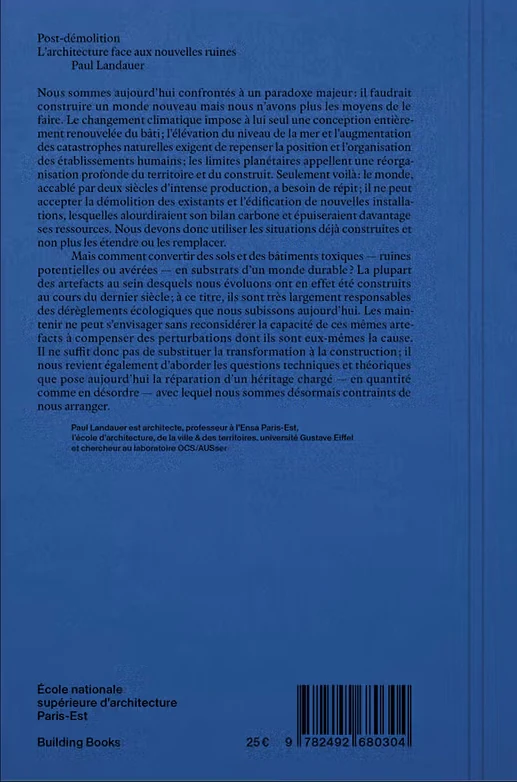


Paul Landauer - Post-démolition, L’architecture face aux nouvelles ruines
"We are currently facing a major paradox: a new world needs to be built, but we no longer have the means to do so. Climate change alone requires a completely new approach to building design; a rise in sea levels and an increase in natural disasters call for a rethink of the location and organisation of human settlements; planetary limits demand a profound reorganisation of land use and construction. The fact is, however, that the world, burdened by two centuries of intense production, needs a respite; it cannot accept the demolition of existing structures and the construction of new facilities, which would increase its carbon footprint and further deplete its resources. We must therefore make use of existing structures rather than extending or replacing them.
Yet how can we convert polluted land and buildings—potential or proven ruins—into substrates for a sustainable world? Most of the artefacts we live among were built during the last century; as such, they are largely responsible for the ecological disruptions we are experiencing today. Maintaining them cannot be considered without re-evaluating the capacity of these same artefacts to compensate for the damage they themselves have caused. It is therefore not enough to replace construction with transformation; we must also address the technical and theoretical issues raised today by the repair of a legacy—both in terms of quantity and disorder—which we are now compelled to deal with."
In this stimulating illustrated essay, between history and theory, Paul Landauer analyses how architects have considered the ruins of modernity since the end of the 20th century.
Graphic Design: Building Paris
Typefaces: Immortel Infra (Clément Le Tulle-Neyret, 205TF), Antique Legacy (Optimo)
Printed by Tallinn Book Printers in Tallinn (EE)
2025
Softcover with flaps
15×23 cm
208 pages
French
74 black & white documents
ISBN 978-2-492680-30-4
Coedited with the École nationale supérieure d’architecture Paris-Est
© Building Books
Product Information
Product Information
Shipping & Returns
Shipping & Returns
Description
"We are currently facing a major paradox: a new world needs to be built, but we no longer have the means to do so. Climate change alone requires a completely new approach to building design; a rise in sea levels and an increase in natural disasters call for a rethink of the location and organisation of human settlements; planetary limits demand a profound reorganisation of land use and construction. The fact is, however, that the world, burdened by two centuries of intense production, needs a respite; it cannot accept the demolition of existing structures and the construction of new facilities, which would increase its carbon footprint and further deplete its resources. We must therefore make use of existing structures rather than extending or replacing them.
Yet how can we convert polluted land and buildings—potential or proven ruins—into substrates for a sustainable world? Most of the artefacts we live among were built during the last century; as such, they are largely responsible for the ecological disruptions we are experiencing today. Maintaining them cannot be considered without re-evaluating the capacity of these same artefacts to compensate for the damage they themselves have caused. It is therefore not enough to replace construction with transformation; we must also address the technical and theoretical issues raised today by the repair of a legacy—both in terms of quantity and disorder—which we are now compelled to deal with."
In this stimulating illustrated essay, between history and theory, Paul Landauer analyses how architects have considered the ruins of modernity since the end of the 20th century.
Graphic Design: Building Paris
Typefaces: Immortel Infra (Clément Le Tulle-Neyret, 205TF), Antique Legacy (Optimo)
Printed by Tallinn Book Printers in Tallinn (EE)
2025
Softcover with flaps
15×23 cm
208 pages
French
74 black & white documents
ISBN 978-2-492680-30-4
Coedited with the École nationale supérieure d’architecture Paris-Est
© Building Books